Our booking pick: The boat trip from Carvoeiro, free cancellation up to 24 hours before. Book this Compare the options
Benagil is a hamlet in the parish of Lagoa e Carvoeiro, a fishing village until the late twentieth century and now the name of the most photographed cave on the Algarve. The cave sits a short paddle east of the beach, inside the Parque Natural Marinho do Recife do Algarve - Pedra do Valado, a marine natural park created in 2024.
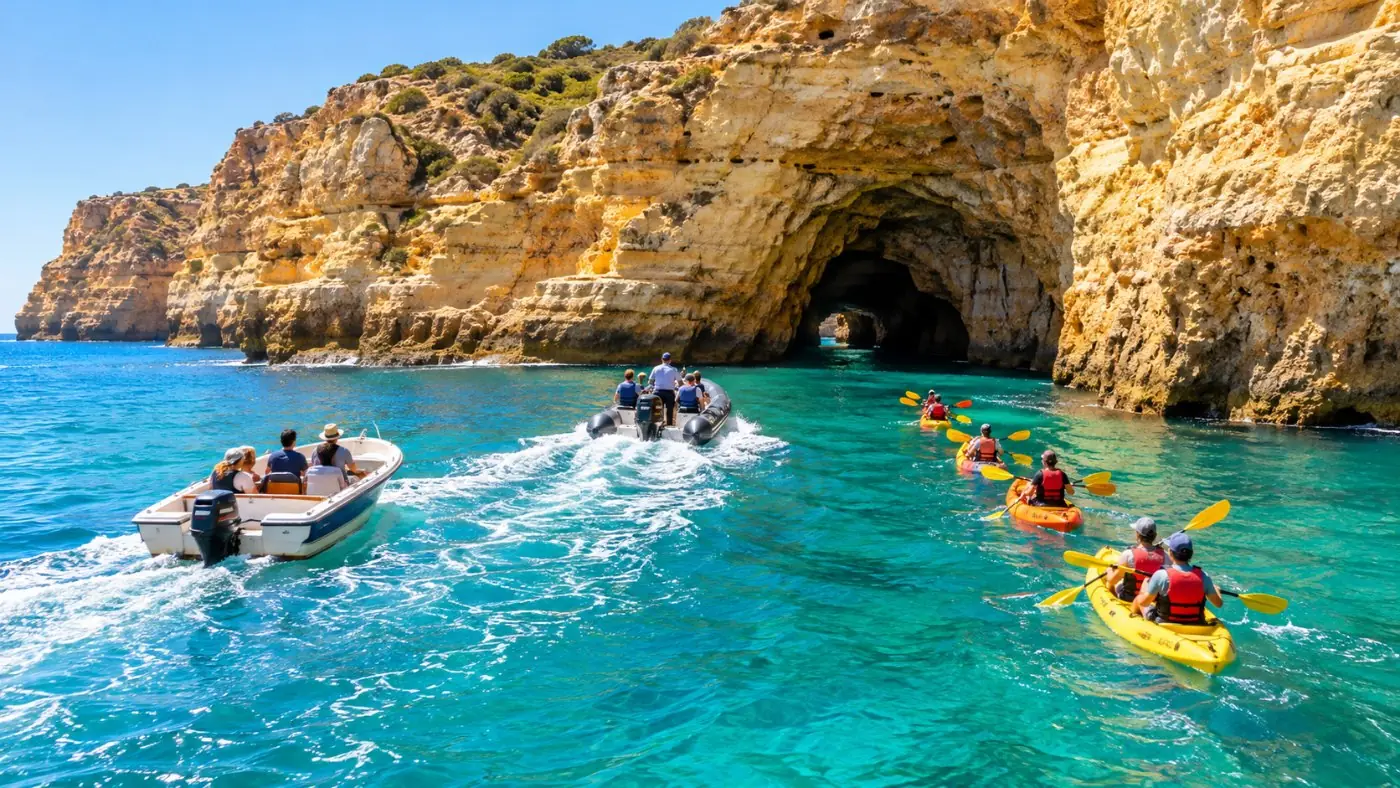
Since August 2024 the cave is regulated by an edital of the Capitania do Porto de Portimão: licensed boats stay inside for two minutes, guided kayak groups for up to eight, nobody lands on the sand and nobody swims in. Those rules change what a fact page can honestly say, because the photographs that made the cave famous show things that are no longer allowed. The boat tours linked here are GetYourGuide listings; their durations and routes come from each listing.
The short answer
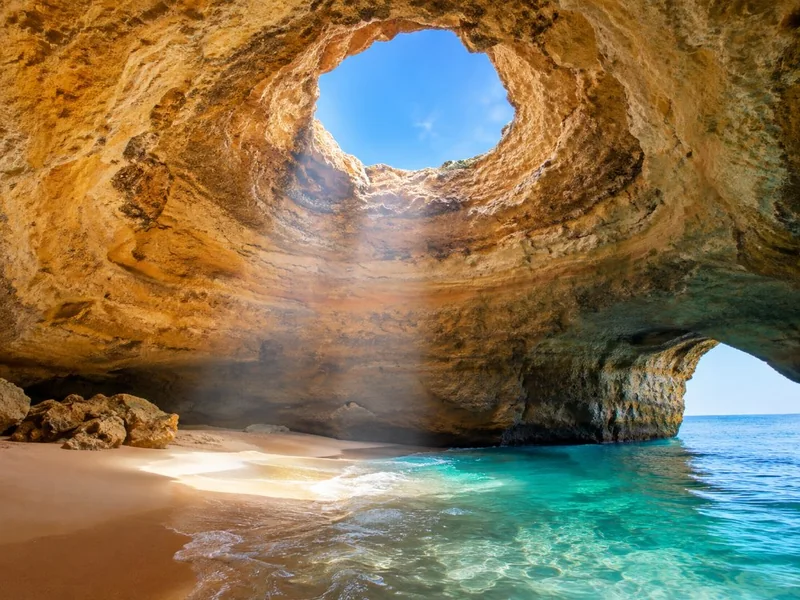
Benagil cave is a Miocene limestone sea cave eroded from the side by the Atlantic and from the top by rainwater, which is why it has both sea openings and a round skylight above a small inside beach. Wikipedia describes it as the only cave between Lagos and Albufeira shaped that way. The rock is roughly twenty million years old; nobody has dated the cave itself. The name is said roughly beh-nah-ZHEEL, and locals call the hole o olho, the eye. It went viral in the early 2010s and has been visited under strict rules since 2024.
What is special about the Benagil caves?
The combination of sea openings, a roof skylight and a beach inside. Wikipedia lists it as the only sea cave between Lagos and Albufeira eroded from the side and from the top.
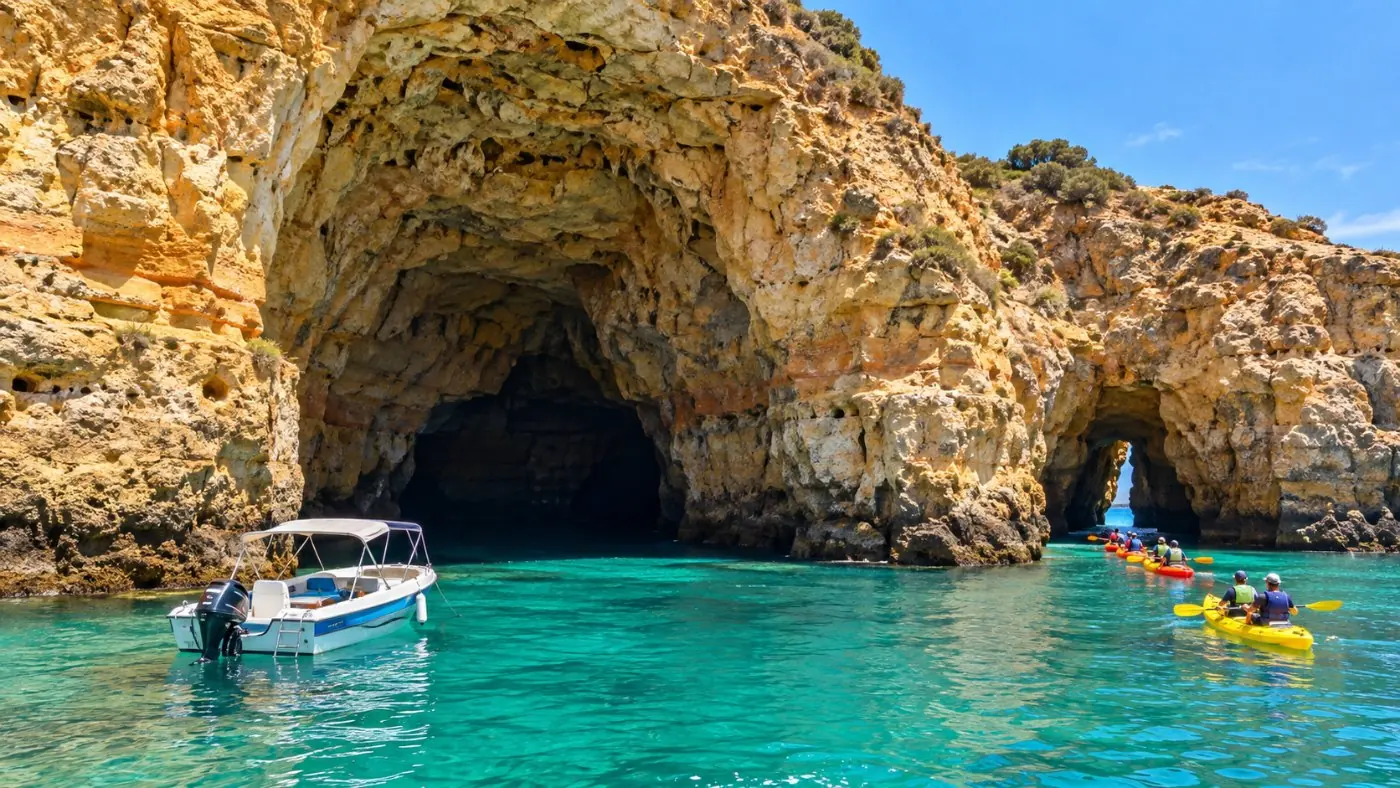
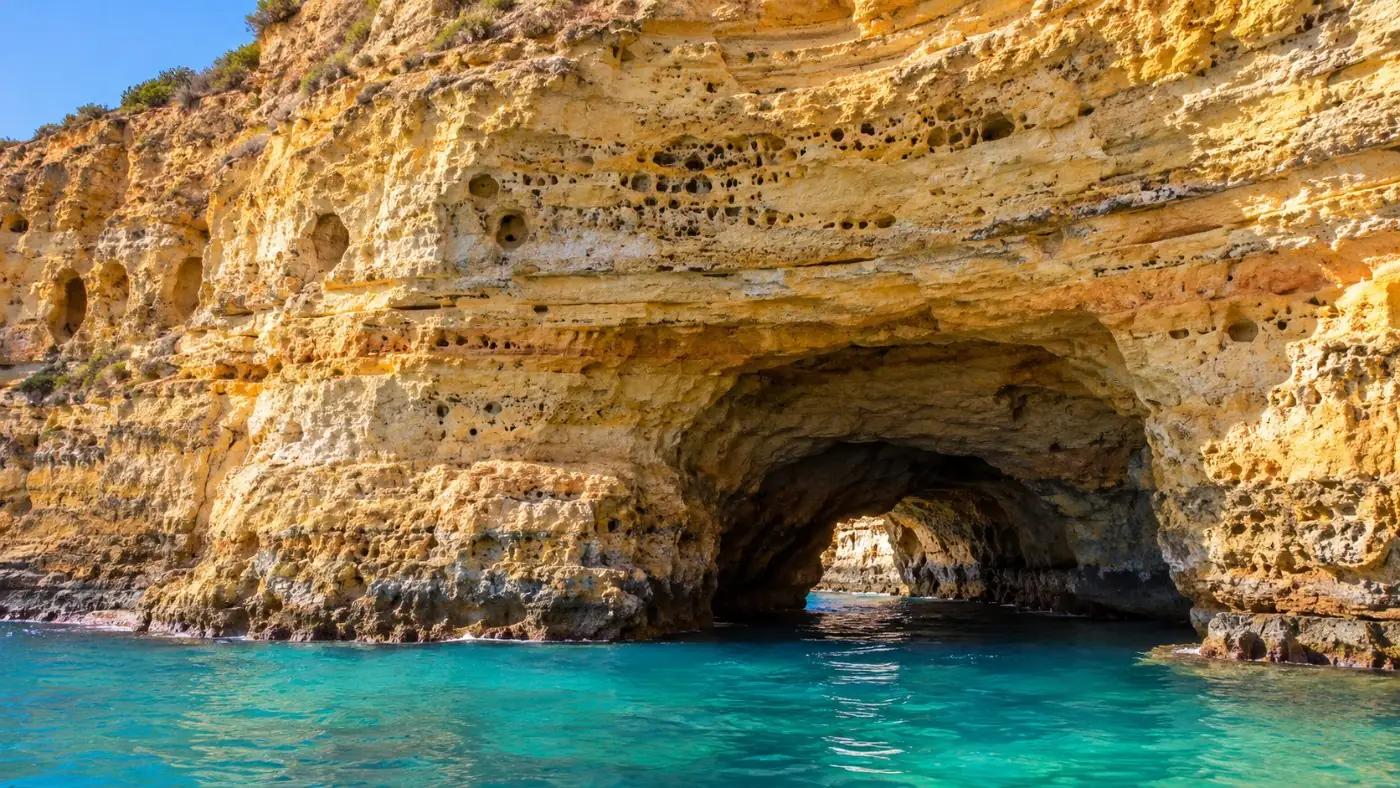
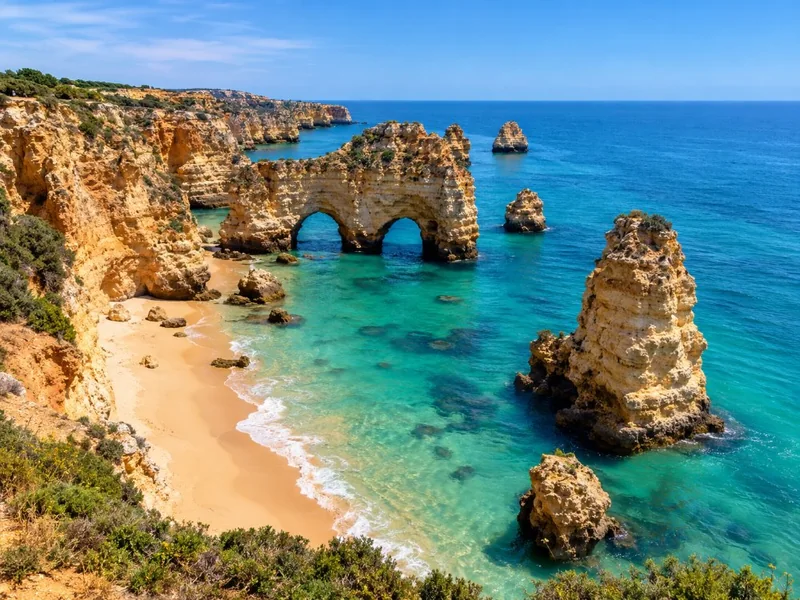
Sea caves along the Lagoa coast are common. Walk the clifftop from Carvoeiro to Praia da Marinha and you pass arches, tunnels, a large sinkhole and dozens of caverns cut into the cliff. The Benagil boat from the beach passes fifteen to twenty caves in an hour, according to its listing. What sets the Algar de Benagil apart is that it was hollowed out twice: the sea cut in from the side and made the two openings boats and kayaks use, and water working down from the clifftop opened the roof.
The result is a domed room with daylight falling from above onto a crescent of sand that the sea leaves at the back. That beach is the reason for the famous photographs and the reason for the ban: landing on it has been prohibited for everyone since August 2024, and swimming in was already banned. Today the sand is seen from the water for two minutes, or from behind a fence on the clifftop for as long as you like. The clifftop route is described in our guide to seeing Benagil cave from above.
How old are the Benagil caves?
The limestone is Miocene, roughly twenty million years old. The cave itself is far younger, and no published figure gives its age.
The cliffs from Carvoeiro to Armação de Pêra are cut in Miocene limestone, a marine rock laid down when this coast was shallow sea. That gives a ceiling for the age of any cave in it: the cave cannot be older than the rock, and the rock is of the order of twenty million years old.
The hollowing came much later. Caves in soft coastal limestone form and collapse on timescales of thousands of years rather than millions, and the present sea level, which does the side erosion, has only stood where it is for a few thousand years. How many thousand, for this cave, nobody has published. The sources this site uses do not give a date for the cave or for the roof collapse, so neither does this page. Any precise age you read elsewhere is a guess dressed as a fact.
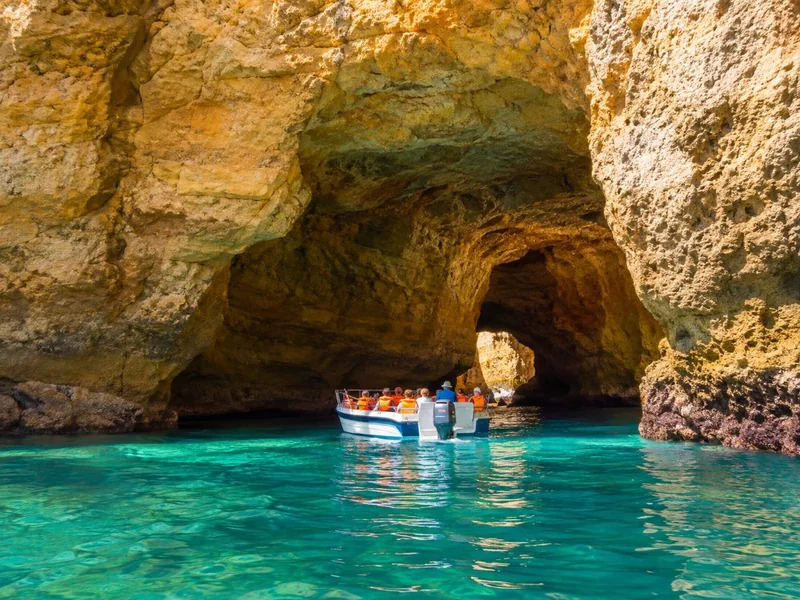
From Carvoeiro past Algar Seco, Vale Covo and the Alfanzina lighthouse to the cave: the listing states a one and a half hour trip with a skipper and a guide on board.
Book thisHow was Benagil cave formed?
By karst erosion from two directions: rainwater dissolving the limestone from above and Atlantic waves cutting in from the side, until part of the roof collapsed and left the skylight.
Limestone dissolves in slightly acid rainwater. Over a long time, water sinking through cracks in the clifftop widens them into shafts and chambers; this is the karst process that gives the region its sinkholes, and the Portuguese word algar, used in the cave's name, means exactly that: a sinkhole or pothole. The large sinkhole you pass on the Seven Hanging Valleys trail is the same process seen from above.
At the base of the cliff the Atlantic works sideways. Waves compress air in cracks, pull out loose blocks and carve a cavern at the waterline. Where a karst shaft from above met a wave-cut cavern from below, the thinned roof fell in. The oculus of Benagil is that collapse. The sand inside is simply what the sea carries in and leaves at the back, out of reach of most waves.
The process has not stopped. The edital requires operators to report rockfalls to the Capitania within two hours and to wear helmets near rockfall-risk cliffs, and the clifftop around the skylight is fenced because the rock at its edges is thin.
How do you pronounce Benagil?
Roughly beh-nah-ZHEEL, with the stress on the last syllable and a soft g as in genre. Algar is the Portuguese word for a sinkhole; locals call the cave o olho, the eye.
English speakers tend to say BEN-a-gill with a hard g. In Portuguese the stress falls on the final syllable and the g before i is soft, closer to the s in measure. Say beh-nah-ZHEEL and you will be understood at the ticket shop. This site has not found an official pronunciation guide, so treat the spelling as an approximation.
Two more words help. Algar (ahl-GAR) is a sinkhole or pothole, so Algar de Benagil is the Benagil sinkhole, a name that describes the hole in the roof rather than the sea entrance. O olho, the eye, is what locals call it: look down from the clifftop and the name explains itself.
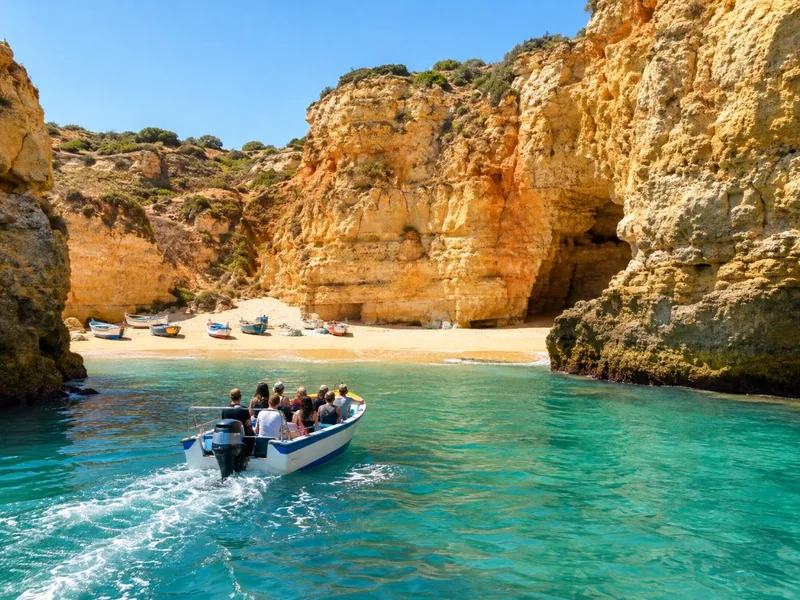
Depart from Benagil beach itself: the small-group Taruga boat takes up to ten people past fifteen to twenty caves and the Alfanzina lighthouse, with check-in thirty minutes before at the ticket shop in the village, according to the listing.
Book thisWhy are the Benagil caves so famous?
Photographs. The cave went viral in the early 2010s, and the pictures of people standing on the inside beach under the skylight travelled around the world. Those pictures can no longer be taken.
Before the smartphone era the cave was known to local boatmen and to visitors on the Carvoeiro grotto trips. From the early 2010s a single image took over: a person on the sand inside, lit from above through the round hole, with the blue of the sea in the openings behind. It spread on social media and in travel lists, and the summers that followed brought swimmers stranded inside by the swell, boats, SUPs and kayaks crossing paths in the openings, accidents in the grotto and rescues.
The response came in stages. An interim restriction in October 2023 limited access after that summer. A government working group led by CCDR Algarve ran a public consultation in 2024 and set a carrying capacity, and the Capitania do Porto de Portimão issued Edital 019/2024, in force from August 2024, amended in July 2025. The Algarve tourism board said in June 2025 that the incidents of overcrowding and craft crossing paths had stopped and that the rules would stay.
The fame remains; the photograph has changed. Today it is taken from a boat or a kayak looking up, or from the clifftop looking down. Anyone selling you the old picture is selling you something illegal. What the rules say in detail is in our guide to the Benagil cave rules.
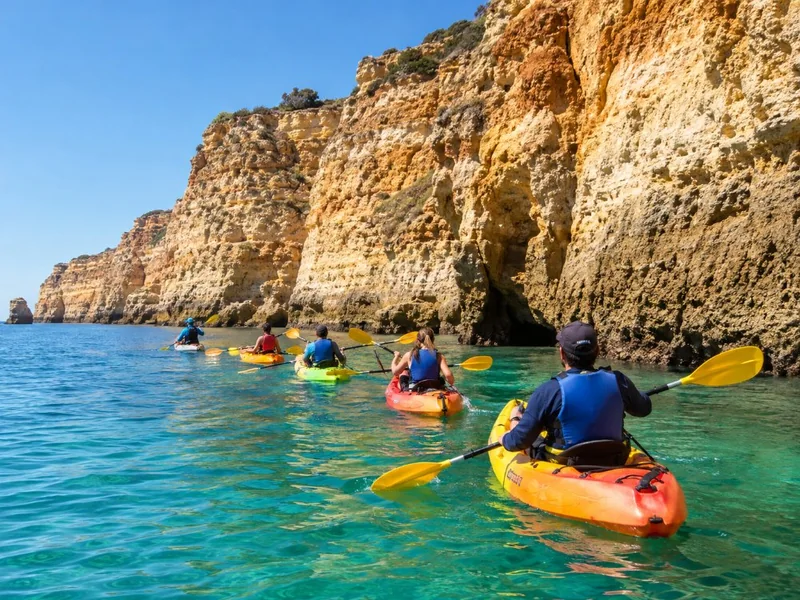
Is Benagil the most beautiful cave in the world?
That is an opinion, and lists that say so are opinions too. What can be verified is narrower: a sea cave with a skylight and an inside beach, described by Wikipedia as the only one of its kind between Lagos and Albufeira.
Benagil appears on many ranked lists of caves, beaches and natural wonders. None of those rankings measure anything. They are editorial choices, often copied from one another, and this site does not repeat them as facts. Beauty is also partly timing: the cave in late-morning light from May to October is a different place from the cave in flat December light, and a two-minute visit in a boat is a different experience from eight minutes in a kayak.
What survives a source check is this. It is a karst and wave-cut sea cave in Miocene limestone. It has a roof opening and a beach inside. It lies inside a marine natural park. It is regulated by a published edital with a two-minute limit for boats. And it is, per Wikipedia, the only cave on this stretch of coast eroded from both the side and the top. That is enough to justify the trip without a superlative.
| Claim you will read online | What the sources say |
|---|---|
| You can swim into the cave | Prohibited by Edital 019/2024; entering by swimming or with floating aids is banned |
| Boats drop you on the beach inside | Prohibited since August 2024; landing on the sand is banned for everyone |
| Rent a kayak and paddle in yourself | Unguided kayak and SUP tours and rentals are not allowed in the area under the 2025 text |
| The cave is closed | Not closed; access is regulated, with licensed boats and guided paddle groups only |
| You can hike down into the cave | Impossible; the cliffs are sheer and the trail gives the view from the fenced clifftop only |
| Each swimmer pays a fixed fine | The widely quoted per-swimmer figure is not in the official text; fines are set in ranges for operators and individuals |
| The cave is X thousand years old | No published date exists for the cave; the limestone is Miocene, roughly twenty million years old |
| Boats spend ages inside | Two minutes for a motor boat, up to eight for a kayak group, by law |
What are the best caves to visit in the Algarve?
Benagil first, then Algar Seco at Carvoeiro, Paradise Cave with its wider skylight, the Captains' Cave near Armação de Pêra, and the grottoes of Ponta da Piedade at Lagos.
Most boat tours on this coast bundle several caves, and the names below all appear on the routes of the listings on this site or in the sources used here:
- Algar Seco, at Carvoeiro: rock pools, arches and a cave open to the sea, reachable on foot from the village and passed by the Carvoeiro and Portimão boats.
- Paradise Cave: a separate cave near Benagil with a wider skylight than the famous one.
- Captains' Cave and the arch of Albandeira: on the Armação de Pêra boat route, which lists about ten caves and fifteen wild beaches.
- The caves between Benagil and Marinha: the one-hour boat from Benagil beach passes fifteen to twenty of them plus a swallow hole, according to its listing.
- Praia do Carvalho: a beach reached through a rock tunnel, on the clifftop route and most boat routes.
- Ponta da Piedade, at Lagos: a headland of stacks and grottoes further west, on the route of the Lagos tour, which the listing states takes two and a half hours including a dolphin search.
The Carvoeiro boat trip strings the western group together: Algar Seco, Vale Covo, Praia do Carvalho, the Alfanzina lighthouse, the Benagil cave and the arches of Praia da Marinha, with an optional swim stop outside the caves when conditions allow. Which departure point makes sense for where you stay is covered in our comparison of the Benagil cave tours.
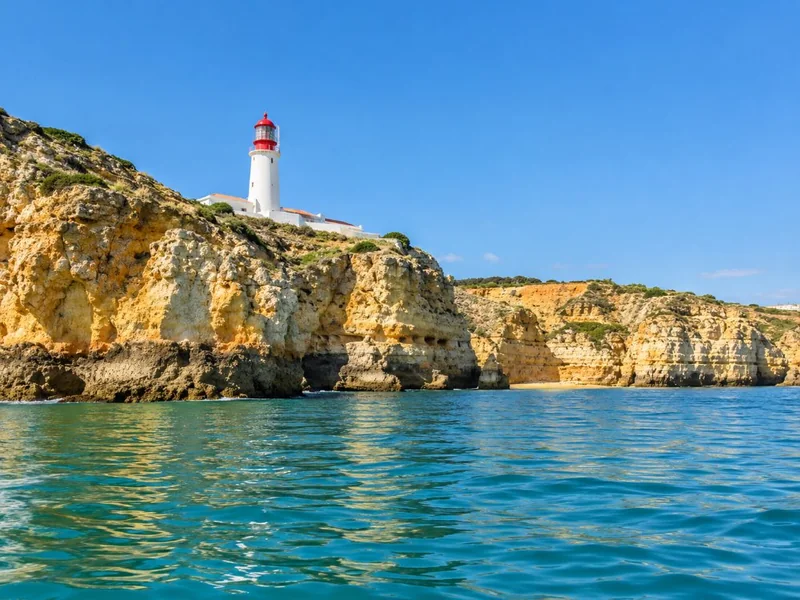
What is Benagil village like?
A hamlet of about sixty residents above a small cove, a fishing village until the late twentieth century. A few restaurants, a small car park, no supermarket, and a coast inside a marine natural park.
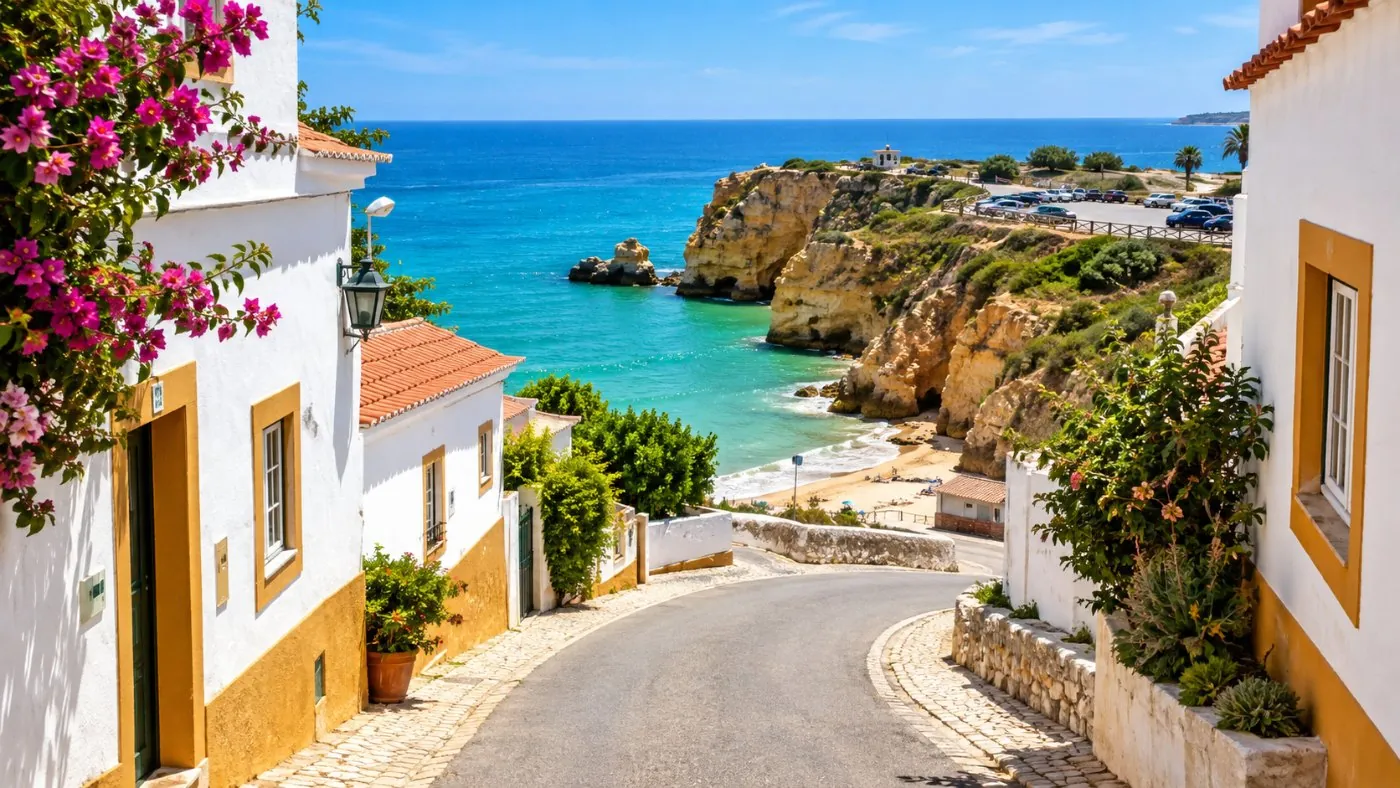
Benagil belongs to the parish of Lagoa e Carvoeiro in the municipality of Lagoa. The houses stand on the slope above Praia de Benagil, a cove with fishing boats on the sand and the cave a short paddle to the east. Praia da Marinha is the next beach along. The village has a beach bar, a beach club, a handful of restaurants and no supermarket; most of the beach-facing businesses close in winter.
Parking is the practical problem. The clifftop lot is small, part-paid and full by mid-morning in summer, which is why the kayak listing tells you to arrive forty-five to sixty minutes early in high season. The infrequent bus from Lagoa runs twice a day on weekdays. The water off the village is part of the Parque Natural Marinho do Recife do Algarve - Pedra do Valado, created by a Council of Ministers resolution in 2024, which is one more reason the cave is managed the way it is.
If you want to walk, the clifftop path from Praia de Benagil to the skylight takes five to ten minutes, and on to Praia da Marinha about half an hour. The guided Seven Hanging Valleys walk starts at Marinha instead and spends about thirty minutes at the skylight, according to its listing.
See the cave from above with a guide: the Seven Hanging Valleys walking tour spends thirty minutes at the skylight and explains the geology, in a listed two hours from Praia da Marinha.
Book thisFrequently asked questions
Is Benagil cave natural or man-made?
Natural. It is a karst and wave-cut sea cave in Miocene limestone, with a roof opening left by a collapse. Nothing about it was built.
Can you stand on the beach inside Benagil cave?
No. Landing on or using the sand inside the cave has been prohibited for everyone since August 2024 under Edital 019/2024 of the Capitania do Porto de Portimão.
Which cave has a bigger skylight than Benagil?
Paradise Cave, a separate cave nearby, has a wider opening in its roof according to the sources this site uses. It is less photographed and has no inside beach of the same kind.
How many people live in Benagil?
About sixty. Benagil is a hamlet in the parish of Lagoa e Carvoeiro that was a fishing village until the late twentieth century.
Ready to book
Choose your tour
Every listing here offers free cancellation up to 24 hours before. Booked on GetYourGuide.
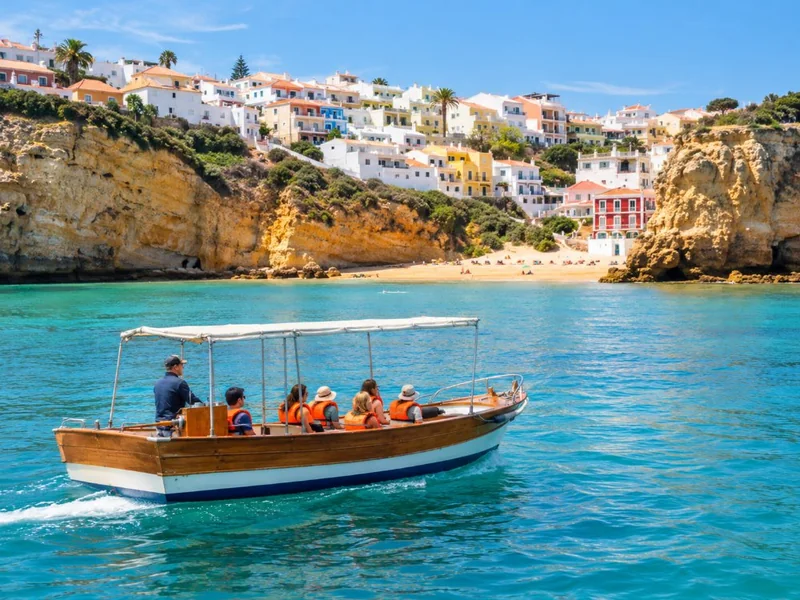
From Carvoeiro: Benagil Caves & Praia da Marinha
The closest town departure: Algar Seco, Vale Covo, Carvalho and the lighthouse on the way, the cave itself, then the Marinha arches and an optional swim stop outside the caves
From Benagil: Small-Group Coast & Cave Boat Tour
- Captain and live guide in English, Portuguese or Spanish, according to the listing
- Boat limited to 10 participants
- Check-in 30 minutes before departure at the ticket shop in Benagil
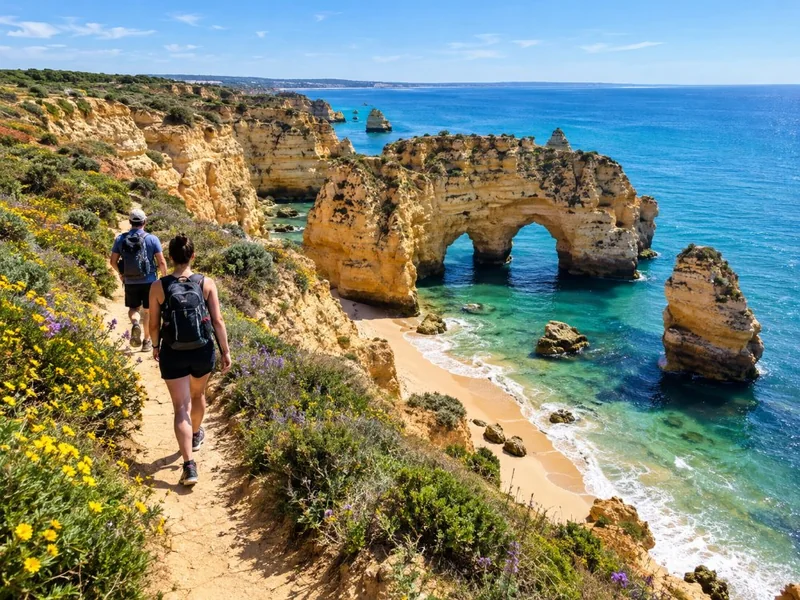
Seven Hanging Valleys Walking Tour from Praia da Marinha
The free view with a guide who explains it: a two-hour walk from Praia da Marinha along the clifftop to the fenced skylight above the cave, with observation decks, the geology and the flora on the way. No transport and no boat; the listing asks for comfortable shoes, water and some stamina for steps and uneven ground.